A Christian school of health for every family
Book Consult
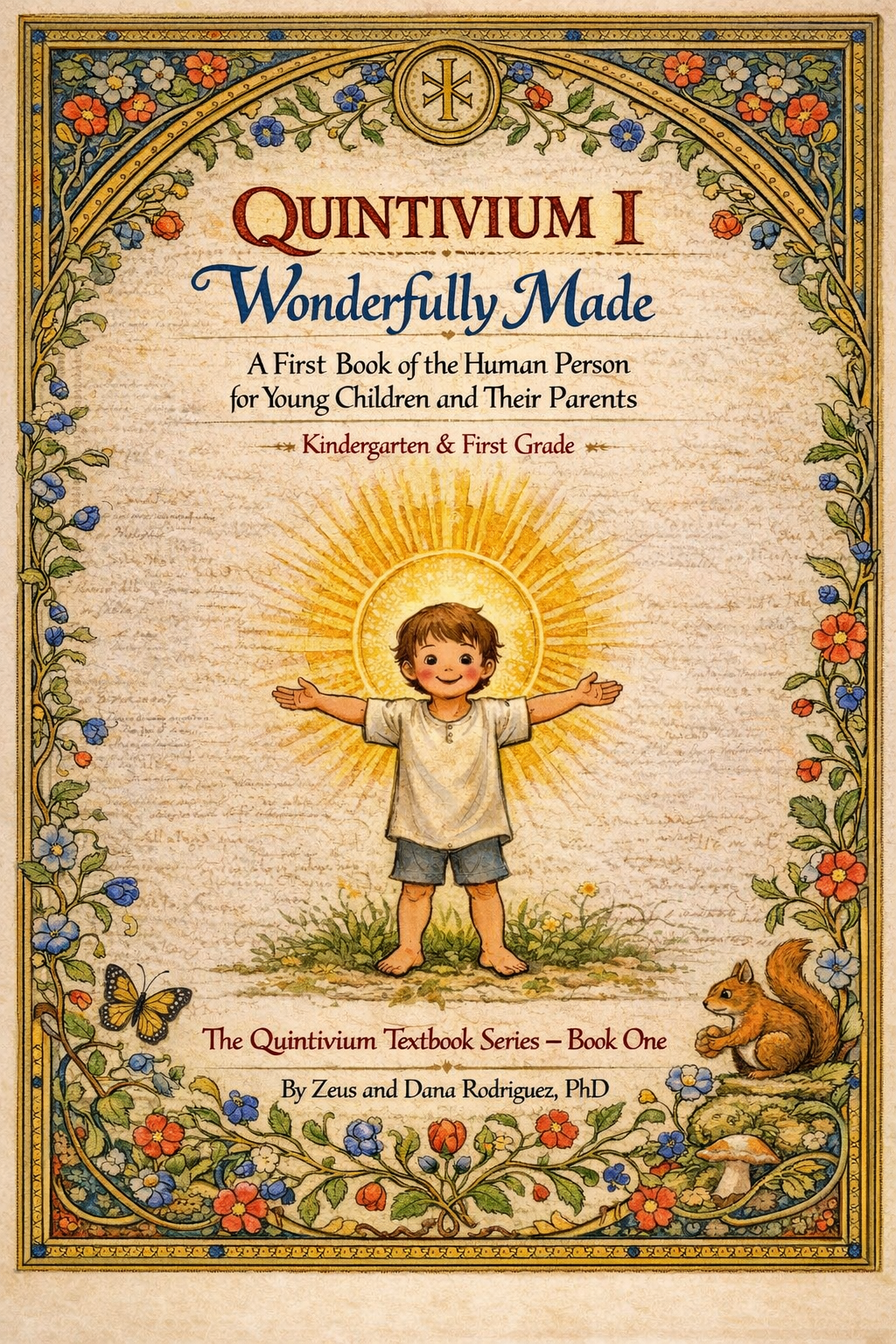
The Quintivium Vol. I: Wonderfully Made — Kindergarten textbook cover
Volume I · Wonderfully Made · Kindergarten
by Zeus Rodriguez & Prof. Dana Rodriguez, PhD · Forthcoming
The Third Pillar of the Liberal Arts

The Quintivium

“Trivium, Quadrivium, Quintivium.”Grammar of the word, grammar of the cosmos, grammar of the body.

In Active Authoring

Twelve volumes. Five liberal arts of the person. Eleven body systems revisited every year at increasing depth. One continuous Christian argument across K–12 about what the human body is for. The third pillar of the classical liberal arts — not a supplement, not an elective, but a required core subject equal in stature to mathematics and language arts.

A Note from the Curator

The classical West named three stages of the liberal arts: the Trivium (grammar, logic, rhetoric), the Quadrivium (arithmetic, geometry, music, astronomy), and — in our re-reading — the Quintivium: the five arts of the person. Christian education has always been missing a native grammar for the human body. Vitae is authoring one. Every claim on this page is forward-looking until the first volume releases; we will never pretend the curriculum is ready before it is.

Movement I · The Architecture

Three Axes of the Quintivium


The curriculum is built on three intersecting axes — vertical, horizontal, and temporal. Each volume sits at the intersection of all three.

Axis I · Vertical

Eleven Systems of the Body

What we study — anatomical

The eleven major body systems of human physiology are revisited every year, K–12. At each grade, students engage the same system at a deeper level.

  • Kindergarten: “your heart is a pump that beats all day”
  • Fifth grade: “cardiac output and the pulmonary circuit”
  • Eleventh grade: “preload, afterload, and Starling's law”
Axis II · Horizontal

Five Liberal Arts of the Person

How we study — the five arts

Within each year, every unit passes through all five arts in sequence: Body, Mind, Ethics, Theology, Politics. We look at the cardiovascular system first as anatomy, then as passion, then as stewardship, then as sacramental reality, then as civic gift.

  • Body first, politics last
  • Each art integrates the previous
  • Never anatomy alone; never theology alone
Axis III · Temporal

Twelve Years, One Argument

When we study — the grade arc

Across K–12, the same argument unfolds from the child's first “wonderfully made” to the senior's Christian Bioethics & Vocational Mentorship. Each volume ends where the next begins.

  • K–2: Wonderfully Made
  • 3–5: Stewards of the Body
  • 6–8: The Integrated Self
  • 9–10: Human Dignity & the Body
  • 11–12: Christian Bioethics & Vocation
From the Book of Wisdom
“For it was thou who didst form my inward parts, thou didst knit me together in my mother's womb. I praise thee, for thou art fearful and wonderful. Wonderful are thy works! Thou knowest me right well.”
Psalm 139:13–14 · RSV-CE
Movement II · The Five Arts

Five Liberal Arts of the Person


Body-first, politics-last. Every unit of every volume flows through these five in order, because each art depends on the one before.

I. Ars Prima τὸ σῶμα

Body

Anatomy, physiology, and the stewardship of the human frame as a temple of the Holy Spirit.

anatomyphysiologyhygiene
II. Ars Secunda ὁ νοῦς

Mind

Passions, intellect, and the Christian ordering of desire — psychology as formation.

passionsattentionmemory
III. Ars Tertia ἰθος

Ethics

Cardinal and theological virtues applied to the body: prudence, temperance, justice, courage.

virtuehabitconscience
IV. Ars Quarta Θεολογία

Theology

Theology of the Body, Christian anthropology, and the sacramental meaning of the person.

imago Deisacramentresurrection
V. Ars Quinta Πολιτεία

Politics

The body in community — family, parish, hospital, republic. CST as applied physiology.

familycommon goodCST
Movement III · The Systems

Eleven Body Systems, Every Year


Each volume touches all eleven, in spiral order, at the developmentally appropriate depth.

IIntegumentarySkin, hair, nails
IISkeletalBones & joints
IIIMuscularMovement & labor
IVNervousBrain, spinal cord, senses
VEndocrineHormones & rhythm
VICardiovascularHeart & blood
VIILymphatic / ImmuneDefense & healing
VIIIRespiratoryLungs & breath
IXDigestiveFood, nutrition, gut
XUrinaryKidneys & balance
XIReproductiveGeneration & vocation
+The Whole PersonIntegration, every year
Movement IV · The Claim

A Required Core Subject

On launch, the Quintivium & Vitae Formation will be a required core subject at every Virtualis campus — not a supplement, not an elective. Equal in stature to mathematics and language arts. The third pillar.

Pillar I

Trivium

Grammar, logic, rhetoric. The arts of the word. Traditionally the first stage of the classical curriculum.

Pillar II

Quadrivium

Arithmetic, geometry, music, astronomy. The arts of number and the cosmos — the mathematical arts.

Pillar III

Quintivium

Body, Mind, Ethics, Theology, Politics. The arts of the person. The missing native grammar for Christian anthropology of the body.

Movement V · What Makes It Different

Not a Health Textbook in Disguise


There are already many K–12 health curricula. The Quintivium is different because it takes a position and defends it.

Difference I

Practitioner-Authored

Prof. Dana Rodriguez, PhD, PNP-BC, co-authors every volume. This is not an editor's compilation of existing resources; it is a working clinician's written curriculum, shaped by twenty-one years of practice.

Difference II

RSV-CE Scripture Throughout

Every volume is Scripturally anchored. Psalm 139 runs through the K volume; 1 Corinthians 6 runs through the high-school bioethics volume. Scripture is not bolted on — it is one of the five arts.

Difference III

Body-First, Not Body-Last

Unlike curricula that treat the body as a distraction from mind and soul, the Quintivium treats the body as the starting point. Anatomy grounds psychology; psychology grounds ethics; ethics grounds theology.

Difference IV

Voice Shifts by Age

K–5 is written as story and fable. Grades 6–12 are written as textbook prose. Every volume is illustrated. Every volume is cited.

Difference V

Classical Sources, Cited

Galen, Hildegard, Trota, the Tacuinum, Aquinas, Vesalius, John Paul II — named and quoted. The Western tradition is the curriculum's long memory.

Difference VI

Integrated with a Clinic

Alone among K–12 health curricula, the Quintivium's authoring clinician actually practices. The curriculum and the clinic are one institution.

From “The Habit of Perfection”

Elected Silence, sing to me And beat upon my whorlèd ear, Pipe me to pastures still and be The music that I care to hear.

Gerard Manley Hopkins, SJ · 1866

Read the first sample — join the waitlist

Open a sample kindergarten week, or put your email on the first-to-know list for the Quintivium's release.